
I have long been interested in the connection between cycling and amateur self-portraiture. Anyone familiar with the world of bicyclists' image galleries is also familiar with the ubiquitous "panda shots," storefront reflections, snapshots of one's bike shadow. Taken quickly with tiny low-quality cameras, these provide spontaneous glimpses into how we move through the world, what we encounter along the way, and how we relate to our bicycles while doing so. Over the years it has become a distinct genre.
But why do it? Looking in from the outside, it is easy to interpret it as a contemporary obsession with documentation, a marking of territory, or in the case of "panda shots" (pictures of yourself taken while cycling) as a showing off of skill. And of course to some extent it is all that. But what makes it bike-specific? I have never encountered another group outside of the art world that is as prone to self-portraiture as cyclists. Joking around with bikeyface, we tried to start a trend for "walk pandas," but somehow pedestrian self-portraiture does not hold the same appeal.

Last year I wrote aboutbicycle blogs and exhibitionism - describing a culture among the blogs of beginner female cyclists where women communicate and encourage each other by showing pictures of themselves doing everyday bike-related activities. Outside of the intended audience (for example, when observed by experienced male cyclists), this is sometimes misinterpreted as exhibitionism. But for the intended audience it is in fact a "teaching by doing" sort of tool that can be more effective than any advocacy.
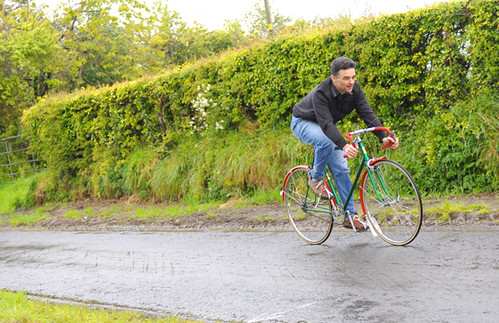
Still the trend for self-portraiture among cyclists is not limited to this alone. It is more widespread than that and encompasses a more diverse demographic. From racers to retrogrouches to randonneurs to pedaling fashionistas, cyclists just seem compelled to snap pictures of themselves on or next to their bikes.

It is possible that moving around by bicycle, particularly when we are new to it in adulthood, heightens our sense of self-awareness and it is this that inspires the self-portraiture. In a sense, the cyclist keeps a visual diary. And a true diary, be it written or visual, is more than just about what happens in one's environment; typically the diarist also focuses on themselves.
How well this works as an explanation, I don't know. But as a psychologist and a painter I am fascinated by the tradition of self-portraiture I've seen emerge as more and more cyclists share their images with the world. If you take pictures of yourself on or with your bike, why do you do it?


 With all the beautiful sunny days and scorchin' temps we've been having lately, some visitors to Rainier might feel like they are actually visiting a Pacific Island rather than on a cold snowy volcano in the Pacific North Wet. It's actually kind of fitting since this month of May, is National Asian American and Pacific Islander Heritage Month.
 Reflected in the receding waves, Morro Rock is the landmark and iconic image of the area.
 An hour or so later, the fog started rolling in.
 Nearly hidden by the fog.
 The sun is about ready to disappear behind the bank of fog, which could be seen for miles along the shoreline. There was no colorful sunset on this night!
 May 1979. I can still feel the freezing cold of the water as I walked through the stream to the dunes. The warmth of the sun and the chill of the morning breeze. The quietness broken only by the occasional laughter and voices of other visitors. It was a time of change. One stage of life ending and another beginning. A return to civilian life after 9 1/2 years in the Navy.





 Samuel Bray Wiseman, his wife and one son are interred at Washington Union Cemetery in Tippecanoe Township, Kosciusko County, Indiana. Samuel and Amanda (Alexander) Wiseman are my great grandparents. Their son Scott, not quite eight years old, died of diphtheria. According to Kosciusko County death records, his full name was Ray Scott.


 Everyone here at the Tumbleweed Crossing wants to wish everyone anywhere a Happy Thanksgiving.


 BD's Fusion spike you can remove. Take a close look at thenew DMM, the newest Grivel "Machine", Edelrid's, Camp's X Dreamoffering orTrango Raptor. Not all the grips are the same. Tight grips for the little pinky limit rotation as do spikes (most every one's) or additional blades (Petzl). Bigger is likely better when it comes to the size of the constriction for the little finger. Smaller is better on the spike. Simply because either in the wrong size(any size?) willlimit the rotation available from the tool. Limited rotation means a unfriendly tool in many ways on pure ice.


