One thorn of experience is worth a whole wilderness of warning. (James Russell Lowell, British Poet and critic)
Thursday, July 3, 2008
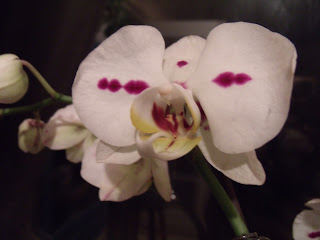
More Orchids
Been trying different locations, lights, and shadows on the orchids I got recently. Here are a few.


Wednesday, July 2, 2008
Soft Diet
Yesterday I had my wisdom teeth removed, and you know - the procedure was not at all bad. Kind of fascinating actually. But the aftermath is the difficult part. My head is splitting even with the painkiller cocktail I am taking, I feel weak and drowsy, and I can't ride a bike for the next few days. But the worst part is eating. For the next week I am supposed to transition from a cold liquid diet to a warm soft one, before I can have regular food again. It isn't easy to procure real meals with these restrictions, especially for a cyclist who is used to consuming lots of calories. For the first day or two the dentist suggested "yoghurt, ice cream and fruit juice," but that is way too much sugar. It occurred to me that with a blender I could liquify normal meals (salmon asparagus smoothie, anyone?), but I don't own one and didn't feel like buying one just to use for a few days. So instead I got some baby food, and it is surprisingly tasty. In a day or two I can graduate to mushed bananas and various soups.
Planning this diet is making me think more about eating during long, strenuous rides. I am not very good at minding my nutritional intake while cycling and have not yet figured out a system that works perfectly for me. For one thing, I simply don't feel hungry when riding strenuously, and I've learned that forcing down random food just to prevent bonking will only make me feel sick. Heavy and sweet foods, such as the pastries cyclists like to eat in cafes, make me nauseous. Dense crunchy things such as energy bars get stuck in my throat and then come back up no matter how hard I try to wash them down with water. Through trial and error, I've learned that I need to stick to soft foods that are easy to swallow, are not too sweet, and are nutritionally dense. Generous bites of a banana every now and again. V8 juice in one of my water bottles. And those soft chewy fruit cubes that are sold in health food stores. If I stick to foods like that, I can eat without breaking my stride and feel good.
I guess what I really want to hear is that even when doing long and strenuous rides I don't have to resort to any of that stuff, that there is some magical combination of regular foods I can make do with instead. Can one ride a randonnéeon bananas, V8 juice and peanut butter? Most serious cyclists I talk to think that's a terrible idea and believe scientifically-formulated nutritional supplements are a must. I am still deciding whether to take that plunge. But for now I will stick to the soft diet and will continue to be the girl with a mangled banana sticking out of her jersey pocket. Once I am back on the bike that is!
Tuesday, July 1, 2008
Petzl Nomic and Petzl Ergo comments.
As much as I like the Nomic I climbed all of last winter in North America with the new Ergo. And for the most part loved every minute of it. We had the earliest ice and some of the latest ice I have ever seen..
For everything I got on the Ergo was big fun. Even easier to climb with on steep terrain than the original Nomic. With a single exception.
There were a few times (OK be honest more than a few) that I was flagging on. I was getting tired. When that happens I get sloppy. Or it was just really cold. I get sloppy then too.

Somewhere we were soloing easy terrain and I was both cold and tired. And I had big gloves on. When all that happens with a pair of Nomic I now realise that I will often drop my little finger (and sometimes even my ring finger)out of the grip and let them hangbelow the rotation point on the tool.
But let me back up a bit here. Petzl has gone to great lengths to add a serrated stainless blade to the pommel of the newest tools. With varying levels of success mind you over two seasons. But what we have now allows you to use the Nomic or Ergo on moderate terrain easier and just as importantly (may be more so) add some stability to the tool on steep ice after a pick stick.
Call the serrated blade in the pommel a good thing. Except when it is not.
New Ergo on the left with theolder style and smooth pommel piece
New Nomic and the new serrated pommel on the right
I and many others have used the originalNomic in alpine terrain to good effect. You adapt and use the tool differently on moderate terrain. But the serrated pommel allows even more use of the Nomic in the mtns. The pommelchange is an improvement in normal conditions.
But on technical ground not so much in a verylimited circumstance. Here is why I think so. Even if I don't drop a finger out of the grip, I want as much rotation from the tool as possible. One reason I think the Fusion is an inferior tool for most in comparison to the Nomic. The spike of the Fusion and the serrated blade on the Nomic will eventually limit the rotation of the tool in the palm of your hand.
I might accept that in the Nomic and have with the newest tools and while climbing with the new Fusion and the spike attached.. But on the Ergo...not so much. Changing picks today on my Ergos I got to thinking..."the Ergo would be a better tool for me on really difficult climbing with the older,smooth and non serrated pommel". Easy change. Now if I drop a finger or two I won't mutilate them at the end of the swing. The stainless serrated pommel will do that and shred a pair of gloves as well if theyget between your finger and the ice.
That experiencecan be painful and indelible.
Easy answer? "Does that hurt?" "Then stop doing *IT*!" If I worked at it Icould always keep my hands and arms in the bus. But being tired comes with the game as does cold temps and big gloves. Generally if I have my Ergos out I am likely to get bit again. So I changed the pommels to the original style. Depending on what the climb is I might even change out my new Nomic's pommelsas well.
Not the typical response when looking at the old or new Petzl tools but something to think about if the parts are available. Everyone seems to wantthe new serrated pommel on their old tools. I prefer having the option of both style of pommel. And if I had to chose between the two for every condition I'd stay with the smooth, original ones. I know I'll get tired again and I won't keep my hands and arms inside the bus.
Back to the issue of the pommels themselves.
It is not like I am making this stuff up! What happened to the "old days" when a broken grip rest was the rare and onlyissue with a Nomic?
The new improved - tools just became available again recently in Europe and now here in the US and North America. Already I am getting reports in ofloosepommels.
this is typical:
"Interestingly though I've had mine for 1 month now. Bought a brand new pair at full retailas soon as they hit the shops here in Chamonix. The bottom griprest has already started to wobble on me. Pretty annoying but I was just wondering if you knew of anyone who has had the same issue?"
The answer is, yes. Theone pictured below is not the first I have heard about or seen.
photo courtesy of a CT reader
A fewfailures reportedboth loose inserts andinserts coming out early thiswinter soit is already obvious the "fix" isn't good enough. A liberal application of steel based epoxy kept my Ergos going all of last winter. Only one size grip though because of it. I'd suggest doing the same to your new tools. And I really hate adding this...as dumb as it might sound.......but be gentle with your pommels. You can imagine just how careful I am with mine when mixing and matching pommels. Which has to be analmost acertain recipe for failure until Petzl decides to do this right again.
Petzl reports the new pommel at double the last versions strength.
"How strong is the GRIPREST?
GRIPREST strength was doubled to withstand loads of 300daN."
http://www.petzl.com/en/outdoor/news/events-0//10/12/newly-modified-versions-nomic-and-ergo-ice-axes-are-available

pommel photos courtesy of Dave Searle
For everything I got on the Ergo was big fun. Even easier to climb with on steep terrain than the original Nomic. With a single exception.
There were a few times (OK be honest more than a few) that I was flagging on. I was getting tired. When that happens I get sloppy. Or it was just really cold. I get sloppy then too.
Somewhere we were soloing easy terrain and I was both cold and tired. And I had big gloves on. When all that happens with a pair of Nomic I now realise that I will often drop my little finger (and sometimes even my ring finger)out of the grip and let them hangbelow the rotation point on the tool.
But let me back up a bit here. Petzl has gone to great lengths to add a serrated stainless blade to the pommel of the newest tools. With varying levels of success mind you over two seasons. But what we have now allows you to use the Nomic or Ergo on moderate terrain easier and just as importantly (may be more so) add some stability to the tool on steep ice after a pick stick.
Call the serrated blade in the pommel a good thing. Except when it is not.
I and many others have used the originalNomic in alpine terrain to good effect. You adapt and use the tool differently on moderate terrain. But the serrated pommel allows even more use of the Nomic in the mtns. The pommelchange is an improvement in normal conditions.
But on technical ground not so much in a verylimited circumstance. Here is why I think so. Even if I don't drop a finger out of the grip, I want as much rotation from the tool as possible. One reason I think the Fusion is an inferior tool for most in comparison to the Nomic. The spike of the Fusion and the serrated blade on the Nomic will eventually limit the rotation of the tool in the palm of your hand.
I might accept that in the Nomic and have with the newest tools and while climbing with the new Fusion and the spike attached.. But on the Ergo...not so much. Changing picks today on my Ergos I got to thinking..."the Ergo would be a better tool for me on really difficult climbing with the older,smooth and non serrated pommel". Easy change. Now if I drop a finger or two I won't mutilate them at the end of the swing. The stainless serrated pommel will do that and shred a pair of gloves as well if theyget between your finger and the ice.
That experiencecan be painful and indelible.
Easy answer? "Does that hurt?" "Then stop doing *IT*!" If I worked at it Icould always keep my hands and arms in the bus. But being tired comes with the game as does cold temps and big gloves. Generally if I have my Ergos out I am likely to get bit again. So I changed the pommels to the original style. Depending on what the climb is I might even change out my new Nomic's pommelsas well.
Not the typical response when looking at the old or new Petzl tools but something to think about if the parts are available. Everyone seems to wantthe new serrated pommel on their old tools. I prefer having the option of both style of pommel. And if I had to chose between the two for every condition I'd stay with the smooth, original ones. I know I'll get tired again and I won't keep my hands and arms inside the bus.
Back to the issue of the pommels themselves.
It is not like I am making this stuff up! What happened to the "old days" when a broken grip rest was the rare and onlyissue with a Nomic?
The new improved - tools just became available again recently in Europe and now here in the US and North America. Already I am getting reports in ofloosepommels.
this is typical:
"Interestingly though I've had mine for 1 month now. Bought a brand new pair at full retailas soon as they hit the shops here in Chamonix. The bottom griprest has already started to wobble on me. Pretty annoying but I was just wondering if you knew of anyone who has had the same issue?"
The answer is, yes. Theone pictured below is not the first I have heard about or seen.
A fewfailures reportedboth loose inserts andinserts coming out early thiswinter soit is already obvious the "fix" isn't good enough. A liberal application of steel based epoxy kept my Ergos going all of last winter. Only one size grip though because of it. I'd suggest doing the same to your new tools. And I really hate adding this...as dumb as it might sound.......but be gentle with your pommels. You can imagine just how careful I am with mine when mixing and matching pommels. Which has to be analmost acertain recipe for failure until Petzl decides to do this right again.
Petzl reports the new pommel at double the last versions strength.
"How strong is the GRIPREST?
GRIPREST strength was doubled to withstand loads of 300daN."
http://www.petzl.com/en/outdoor/news/events-0//10/12/newly-modified-versions-nomic-and-ergo-ice-axes-are-available
Monday, June 30, 2008
Three O'Clock Rock Total Soul ..
Steve and I finally coordinated to get some climbing done. The goal was to head out to Darrington and get in a slabtastic time on the nice granite. We talked Sunday night and decided that our second attempt on Dreamer could wait, and we would head to 3 O' Clock Rock to see if we could accomplish multiple routes. We were headed there with the intent of climbing Total Soul (III, 5.10b?) and Silent Running (II, 5.9+?).
We got a late start and arrived at the trail head with no time pieces. We made quick time up the trail and stopped briefly to marvel at some cut tree trunks and a still standing western red cedar that had a 10'+ diameter at the base. Once at the base of the slabs, we made our way to the Total Soul route.
(Photo by Steve Machuga)
As we geared up, we discussed lead options, and I told Steve it didn't matter, I'd have to lead a 5.10 pitch no matter how we split them. So I told him to combine the first two pitches and give me the lead on the third pitch (a 5.7) so that could be my warm up lead. (Using the "Weekend Rock" topos.)
Looking down from two pitches up. (Photo by Steve Machuga)
Apparently I did need the warm up because after struggling to overcome one of the overlaps on the lower 5.9 section, I pulled on the draw to get over it. My lead went smoothly and soon Steve was leading the fourth pitch where the difficulty started to increase.
Starting the third pitch (Photo by Steve Machuga)
This was probably the hottest time on the slab as well. The sun was hitting us directly and we were lower and there was less of a breeze. The fourth pitch was some climbing that followed a quartz dike up with a minor crack system. For whatever reason, it was really hard on the feet and both of us had painful feet from that pitch on. (My feet didn't fully recover until getting a night of sleep.) To add insult to injury, the belay at the top of the pitch was an uncomfortable hanging belay. Fortunately for me, I was moving on to the next lead. Unfortunately, that meant not resting my feet or toes for the 5.10 pitch.
The next pitch starts interestingly enough with a few moves up an overlap to a branch pull and onto some ledges. From the ledges there are two variations; a line of bolts on the left (5.10b) or some on the right (5.10d.) The right looked easier at first, but then looked to be featureless steep slab. After contemplating the right, I choose the left line. I was able to clip the bolt and was attempting to move out left to start up, but couldn't maintain traction with my left foot. After a few balks, I went for it and slipped and fell. (I was at the bolt, so not really a lead climb.) I grabbed the draw to get back on, and then was able to climb through this crux cleanly to a small flake where the going got a bit easier. The pitch finished moving right again, so I experienced a bit of rope drag as I had not anticipated that directional change. After the move right, I went up through a bush to the next belay. (Looking at the Nelson book this morning, he has the ledge labeled "ant farm ledge" which would explain why I had ants crawling up my legs for the duration of this belay.)
Steve leading the second 5.10 pitch
I brought Steve up where he rested his feet on the nice ledge and cursed his luck for having drawn the hanging belays. This would also be the point we were both ran out of water. (Did I mention it was hot? On the drive home, the outside temp was hovering around 90°F. We did have more water waiting for us at the base of the climb though.)
After a short rest, Steve headed out on another challenging pitch. It started out easy enough following some features up to some overlaps. After one overlap the crux moves came climbing on top of a left facing shallow dihedral. Steve paused for a while before finally working out the moves. I kept a keen eye on him and was quick to arrest a fall should he have one. He clipped the second bolt and kept moving. Unbeknown to me, it somehow became unclipped and he used it to clip the third bolt on this steep smooth slab. When I arrived at these moves it took a bit of time to move off a small ledge on the first moves. I could see the minor bulges in the slab on where I wanted to put my feet, but the first right foot felt insecure. After finally deciding on a feature I moved up, only to slip off onto the ledge. Another attempt and I nailed it, keeping my upward progress going as the slab was thin and the climbing uncomfortable on my feet. I arrived at the next hanging belay panting and in considerable foot pain. Rather than stop at the uncomfortable belay, we quickly changed the rack and I headed out onto easier (5.8) ground.
Surmounting the overlap (Photo by Steve Machuga)
This pitch turned out to be the most wandering of the climb and somewhat varied. There was some initial thin moves to a small ledge with a small bush on it. After traversing left on the ledge there was a large overlap to surmount. Since the overlap was large, I couldn't bring my feet too far under it to get over it, which meant a bit of a high step to make it up. After going through a bunch of options, I got my left foot as high as it could go, and then put my right foot on the lowest lip of the overlap. With some manteling, I was up and moving onto the rest of the pitch. This was also the most gear intensive pitch and I placed about three cams and one nut. (I also somehow dropped my #2 Camalot down to pitch 2, so I'll have to replace that when I get the money. Not sure how it fell, as I wasn't even going for a piece at the time.) The rest of the pitch followed some overlaps and corners up to the belay. It was markedly more dirty/mossy than the previous pitches and gave Steve and I the impression people don't always climb the last two pitches.
The final .10b "headwall"
But we did, and after I brought Steve up to the belay he set out on the last 5.10 pitch which was thin and dirty. After gaining the steep slab, there were some leftward moves to the second bolt on thin features. He moved up slowly and made it to a tree from which he brought me up. I found there to be one committing move at the leftward motion, and the rest to be easier (although sketchier due to the dirty factor) than the other 5.10 bits on the route. Once at the top, we wandered around a bit to see some views. (Not much really, it isn't a true summit after all.) We then located the rappel tree (as well as the rappel sign) and mused at the uniqueness.

(Photos by Steve Machuga)
After a rap through the trees to another tree. (A rap anchor made with nylon nautical rope and 4" stainless rap rings.) A rap from the second tree got us back to the top of the 6th pitch. From there it was a bunch of double rope rappels back to the base. (We were able to make it into the gully from the top of the second pitch.)
(Photo by Steve Machuga)
Once back at the packs we drank a lot of water and packed up. We took a short exploratory hike over to another part of the slab before heading down to the car. We arrived back at the car around 6:45pm and drove home.
Overall I was happy with this trip. I really wanted to do more climbing in Darrington and got the chance. I think my rustiness of having only climbed three times since May showed. I think I am capable of climbing that route clean and without the aid. Hopefully Steve and I will head back and climb one or more of the other routes there and perhaps I'll get a little more practice in before heading back.

We got a late start and arrived at the trail head with no time pieces. We made quick time up the trail and stopped briefly to marvel at some cut tree trunks and a still standing western red cedar that had a 10'+ diameter at the base. Once at the base of the slabs, we made our way to the Total Soul route.
(Photo by Steve Machuga)As we geared up, we discussed lead options, and I told Steve it didn't matter, I'd have to lead a 5.10 pitch no matter how we split them. So I told him to combine the first two pitches and give me the lead on the third pitch (a 5.7) so that could be my warm up lead. (Using the "Weekend Rock" topos.)
Looking down from two pitches up. (Photo by Steve Machuga)Apparently I did need the warm up because after struggling to overcome one of the overlaps on the lower 5.9 section, I pulled on the draw to get over it. My lead went smoothly and soon Steve was leading the fourth pitch where the difficulty started to increase.
Starting the third pitch (Photo by Steve Machuga)This was probably the hottest time on the slab as well. The sun was hitting us directly and we were lower and there was less of a breeze. The fourth pitch was some climbing that followed a quartz dike up with a minor crack system. For whatever reason, it was really hard on the feet and both of us had painful feet from that pitch on. (My feet didn't fully recover until getting a night of sleep.) To add insult to injury, the belay at the top of the pitch was an uncomfortable hanging belay. Fortunately for me, I was moving on to the next lead. Unfortunately, that meant not resting my feet or toes for the 5.10 pitch.
The next pitch starts interestingly enough with a few moves up an overlap to a branch pull and onto some ledges. From the ledges there are two variations; a line of bolts on the left (5.10b) or some on the right (5.10d.) The right looked easier at first, but then looked to be featureless steep slab. After contemplating the right, I choose the left line. I was able to clip the bolt and was attempting to move out left to start up, but couldn't maintain traction with my left foot. After a few balks, I went for it and slipped and fell. (I was at the bolt, so not really a lead climb.) I grabbed the draw to get back on, and then was able to climb through this crux cleanly to a small flake where the going got a bit easier. The pitch finished moving right again, so I experienced a bit of rope drag as I had not anticipated that directional change. After the move right, I went up through a bush to the next belay. (Looking at the Nelson book this morning, he has the ledge labeled "ant farm ledge" which would explain why I had ants crawling up my legs for the duration of this belay.)
Steve leading the second 5.10 pitchI brought Steve up where he rested his feet on the nice ledge and cursed his luck for having drawn the hanging belays. This would also be the point we were both ran out of water. (Did I mention it was hot? On the drive home, the outside temp was hovering around 90°F. We did have more water waiting for us at the base of the climb though.)
After a short rest, Steve headed out on another challenging pitch. It started out easy enough following some features up to some overlaps. After one overlap the crux moves came climbing on top of a left facing shallow dihedral. Steve paused for a while before finally working out the moves. I kept a keen eye on him and was quick to arrest a fall should he have one. He clipped the second bolt and kept moving. Unbeknown to me, it somehow became unclipped and he used it to clip the third bolt on this steep smooth slab. When I arrived at these moves it took a bit of time to move off a small ledge on the first moves. I could see the minor bulges in the slab on where I wanted to put my feet, but the first right foot felt insecure. After finally deciding on a feature I moved up, only to slip off onto the ledge. Another attempt and I nailed it, keeping my upward progress going as the slab was thin and the climbing uncomfortable on my feet. I arrived at the next hanging belay panting and in considerable foot pain. Rather than stop at the uncomfortable belay, we quickly changed the rack and I headed out onto easier (5.8) ground.
Surmounting the overlap (Photo by Steve Machuga)This pitch turned out to be the most wandering of the climb and somewhat varied. There was some initial thin moves to a small ledge with a small bush on it. After traversing left on the ledge there was a large overlap to surmount. Since the overlap was large, I couldn't bring my feet too far under it to get over it, which meant a bit of a high step to make it up. After going through a bunch of options, I got my left foot as high as it could go, and then put my right foot on the lowest lip of the overlap. With some manteling, I was up and moving onto the rest of the pitch. This was also the most gear intensive pitch and I placed about three cams and one nut. (I also somehow dropped my #2 Camalot down to pitch 2, so I'll have to replace that when I get the money. Not sure how it fell, as I wasn't even going for a piece at the time.) The rest of the pitch followed some overlaps and corners up to the belay. It was markedly more dirty/mossy than the previous pitches and gave Steve and I the impression people don't always climb the last two pitches.
The final .10b "headwall"But we did, and after I brought Steve up to the belay he set out on the last 5.10 pitch which was thin and dirty. After gaining the steep slab, there were some leftward moves to the second bolt on thin features. He moved up slowly and made it to a tree from which he brought me up. I found there to be one committing move at the leftward motion, and the rest to be easier (although sketchier due to the dirty factor) than the other 5.10 bits on the route. Once at the top, we wandered around a bit to see some views. (Not much really, it isn't a true summit after all.) We then located the rappel tree (as well as the rappel sign) and mused at the uniqueness.

(Photos by Steve Machuga)After a rap through the trees to another tree. (A rap anchor made with nylon nautical rope and 4" stainless rap rings.) A rap from the second tree got us back to the top of the 6th pitch. From there it was a bunch of double rope rappels back to the base. (We were able to make it into the gully from the top of the second pitch.)
(Photo by Steve Machuga)Once back at the packs we drank a lot of water and packed up. We took a short exploratory hike over to another part of the slab before heading down to the car. We arrived back at the car around 6:45pm and drove home.
Overall I was happy with this trip. I really wanted to do more climbing in Darrington and got the chance. I think my rustiness of having only climbed three times since May showed. I think I am capable of climbing that route clean and without the aid. Hopefully Steve and I will head back and climb one or more of the other routes there and perhaps I'll get a little more practice in before heading back.
Quick tour of my choice in biners....
In my "best of" list I mentioned a few biners that I think are stand outs.
It has been a while but I haven't countedhow many different styles and brands of carabiners I currently have. It is more than six.. What I actually use is three or fourstyles and generally just two, maybe three on a regular basis.
I generally try to hold on to my gear so I have carabiners that go back a few years. If you think super light and small 'binersare a "new deal" check some of these out.
The blue Latok mini biner is rated at kN 1700 and weighs 28g. The newest green Metolius mini is rated at kN 2200 @ 26g.
I have to agree with Colin Haley, who once described the Metolius by saying"they finally made a biner that is too small". I have them. I don't use either.
A biner I have used a lot is a bent gate. One of the first imported into the US, the blue gate "New Alp" imported by Climb High from France in the late '70s is on the left. Rated at kN 220 @ 56g. I did most of my hard rock climbing with that biner on my rack. The idea was a quick clip and it worked very well for that purpose. In the middle is a more recent bent gate by Black Diamond that I still use in some situations 19 kN @ 46g. And on the right my current favorite the Trango Super Fly 30g and 24kN
The runner up for my own use on the Trango is the BD Oz @ 30g as well and 20kN. Pretty much the same size and feel. BD is off on the numbers a bit but I use both on my rack now depending on the price they can be had at.
I use three locking biners depending on the required use.Left to right, Trango 40g @ 24 kN,Black Diamond Gridlock 78g @ 22kN and theMammut 78g and 24kN.
And I have a few I am still undecided on. Trango on the left, a small Camp @ 22g and 20kN and the new Petzl @ 30g and 20kN
And finally a carabiner that impressed me while we watched it beingdestroyed at the Grivel factory.
Thehard anodized Grivel Yamma K2W biner, 34g and 27kNthat is individually tested and serial numbered in production. An extra 3 to 7 kN bmp in stregth is a big bump in all these lwtbiners. No quessing either as Griveltests biners like this one to failure on a regular basis.
If nothing else I like consistency. I find it annoyingto climb with all sorts of differing sizesand styles of carabiners on my rack. So I try not to, even if that means we use my rack a lot :-)
Sunday, June 29, 2008
More of Day 3
After the picnic on day 3 we traveled on north to Kalaloch Beach (my guide informed me it was pronounced Clay-lock) - from the mossy trees to the open coast. I am finding out that the trip up the Washington coast has some very unique country and is very interesting.
It was the first time I had seen the ocean in about 4 years. I was thrilled. We took the short hike down to the waters edge, sat on an old log, pulled off our shoes and rolled up our jeans. I couldn't wait to wade into the ocean. But was I surprised! Now I understood why Jan said we wouldn't need our swim suits at the beech. That water was way too cold to get more than our toes into it. There were people who had on swim suits or shorts and were getting wet. Jan said they were probably local people who did it frequently and were used to how cold the water was.
But regardless of the chill (and remember it was August) we waded, made tracks in the wet sand, and looked for sea shells. The tide was coming in and we didn't find anything but broken shells. I took lots of photos of the waves coming into the shore and of the sun just starting to think about sinking toward the west, as well as a few brave kids playing in the surf and building sand castles.
Interestingly there were big, tall trees that came almost down to the shore, leaving only a few feet of sand that varied from 3 or 4 feet up to about 50 feet for the beech area. I was intrigued by this as most of my visits to the beach had been in Florida and southern California where there were usually houses down to the shore or beach's. I had always seen photos of the trees and cliffs by the shore and always wanted to see it. Now I was. There were lots of logs laying everywhere. Great big logs that had once been great big trees. My guide said that sometimes trees fall off of cliffs and get into to the ocean. Other times the logs are lost from logging operations near the shore, or from barges that carry logs on them or they might have been sunk in the ocean for hundreds of years. With the changing of tides and storms they are unburied and wash ashore. Every year a few people are killed when they are playing on the beech and don't notice that there is a log coming in to shore. They are very heavy but the waves and water can throw them tremendous distances making dangerous missiles out of them.
Saturday, June 28, 2008
Blue Ridge Parkway :: Brinegar Cabin
The grounds were neatly mowed. The garden was lying fallow. The cabin was locked. Peeking into the windows revealed nothing but empty spaces, except for a large object covered with a sheet. It was likely the loom used in demonstrations during the “prime” visitor season, summer.


The Brinegar Cabin, at milepost 238.5 on the Blue Ridge Parkway. A placque at the top of the hill overlooking the cabin proclaims:


The Brinegar Cabin, at milepost 238.5 on the Blue Ridge Parkway. A placque at the top of the hill overlooking the cabin proclaims:
The Brinegars were not famous or rich, but they were important to their families and neighbors. In 1876 Martin Brinegar purchased this 125 acre farm from Henderson Crouse, Caroline Joines' uncle, for $200. Two years later Martin and Caroline were married; he was 21 and she was 16. there were many small communities close by where the Brinegars visited their families and friends, traded for supplies, and attended church and school.
Martin and Caroline first lived in a one-room cabin that was already here. Their three children – Alice, Sarah, and John – were born in that cabin. As the family grew Martin built the cabin that stands here now. Their last child, William, was born in this cabin, but died as an infant.
The Brinegars did all the usual work of living on a farm – raising crops and animals, preserving food, and cutting firewood. Martin also made shoes for his neighbors. He was a local justice of the peace and notary public, and for many years he served as clerk for the Pleasant Grove Baptist Church. Caroline made clothing for her family and augmented their income by gathering medicinal plants like bloodroot, snakeroot, and black cherry bark and selling them to nearby drug merchants.
In 1925 Martin was caught in a storm on his way home from church and died from pneumonia eight days later. He was 68. The state of North Carolina bought the Brinegar farm in 1935 to become part of the Blue Ridge Parkway. Although Caroline had a lifetime tenure to stay in her home, she went to live with her daughter Sarah when it became too noisy here for her. Caroline died in 1943 when she was 82.
Subscribe to:
Posts (Atom)