Friday, January 20, 2012

California Saxifrage


California Saxifrage, originally uploaded by ParsecTraveller.

One of the first wildflowers to bloom! This one was growing near a creek high in a canyon in Las Trampas.

Tuesday, January 17, 2012

James Joslin :: In a Matter of Debt

Yesterday afternoon I was going through my "Whitley County" folder and re-discovered a document that I forgot that I had. It was one of those where you got it but you'll do something with it later. So now, later has finally come! This is a page (there were no page numbers) copied from the "Troy Docket" book at the Whitley County Historical Museum. Well, at least it was there back in .. when I made this copy!

It may be or could be the reason that James and Abigail Joslin sold the remainder of their land to Edwin and Joseph Joslin less than a month after this case was filed. I'm still not convinced though. Where, or how, did two young boys, age 14 and 12 respectively, come up with $50 each to purchase the land? Or, perhaps, the $50 was written into the "contract" because that was fair market value? And James "sold" the land to the boys to keep it in the family?

Essentially, in this case, James owned up to the fact that he owed several debts and agreed to pay them. Price Goodrich then put up security and the debts were paid on February 7, 1845. But, I wonder, who actually paid the debts? Did Price? Regardless of how they were paid or who paid them, the debts were satisfied. When all was said and done, James and Abigail no longer owned their land in Troy Township…

=+==+==+==+=

Troy Docket. No page number. Filed July 16, 1844.

Francis L. Machugh Plantiff vs James Joslin Defendant } In an action of debt. Be it remembered that on the sixteenth day of July 1844 Francis L Machugh filed the following as a cause of action against James Joslin on which the following proceedings were had to wit: Four notes discribed as follows No 1 bearing date December 19th 1841 due one day after day amount $6.68 No 2 bearing date November 24th 1843 due one day after date amount $5.00 No 3 bearing date February 25th 1843 due one day after date amount $7.00 No 4 bearing date July the 16th 1844 due on demand (waving all relief on appraisment law) which the plantiff ordered erased and the relief law extended.

On the [blank space] day of of July 1844 a Summons issued directed to George H Stocking constable actionable on the 7th day of August 1844 at 2 o'clock in the afternoon

This day August the 5th 1844, came the defendant of this cause and ordered that Judgement Should be entered against him for the amount of Said notes interest and costs

It is therefore considered that the plantiff recover of Said defendant twenty five dollars and fifty cents debt and damages and all costs with interest thereon at the rat of six percentum per annum from the date of this Judgement

Justices fees summons $ 0 12 ½
Judgement 0 25
Bail 0 25
Const fee Service and interst $ 0 30

I Price Goodrich do hereby acknowledge myself security for the above defendant James Joslin for the payment of the above Judgement with the interest which may have accrued thereon at the expiration of one hundred and twenty days from the rendition of the same and all costs Witness my hand and seal this 5th day of August AD 1844. Price Goodrich {Seal}

Issued on execution January the 6th 1845
February the 7th 1845 execution returned, money made in full
Received of George H Stocking cons $27.78 in full of the foregoing Judgement. James Grant Justice of the Peace

EZ Tools? Finding What Works


I knew that I was pushing my luck, riding a bike that had just been assembled the previous day. And sure enough: 5 miles into the Vermont Fall Classic my dynamo headlight rattled loose. I was just about to rummage around for my folding multitool, when a riding companion, Vorpal Chortle, whipped out a little wrench-looking thingie with multiple heads that I'd never seen or used before. "Here, maybe one of these is the right size?" It was. Without getting off the bike, I tightened my headlight and amoment laterwe were on our way again.


No one thought that anything out of the ordinary had transpired, but I was stunned. This was not what tightening bolts on a bike was normally like for me. This was done without effort, and more importantly, without the usual flood of shame and anger at my helplessness.


I've explained before the situation with working (or rather not working) on my own bikes. It's not that I don't know how or don't want to learn. I can give others tutorials on bike repair. But I have problems with my hands that limit my hand strength, dexterity and fine motor skills. Even just holding some tools is difficult: They fall out out of my hands, because my fingers can't grip them tightly enough or wrap around them in the right way. In the very best case scenario, I might be able to do an easy repair (like tightening a headlight bracket) but it will take ages. I have tried individual wrenches, Y-wrenches and folding multi tools, and it's always the same story. How or why the flimsy looking Park Tool MT-1 was any different was beyond me.


Shortly after the Vermont Classic I bought an MT-1 of my own (available locally at Harris Cyclery), and can now easily handle anything on a bike that requires a 3/4/5/6/8mm allen wrench, an 8/9/10mm socket wrench, or a straight blade screwdriver. That does not cover everything, but it's a start. There is something about the size and shape of this thing that both stays put in my fingers and provides enough leverage to compensate for my lack of hand strength. The joy this has brought me is almost embarrassing (thanks Vorpal Chortle!).


Granted, this particular tool may not work for everyone. But my point is,if you are finding bike repairs physically difficultthere might be something out there that does work. I am going to experiment more aggressively from now on, and maybe I will find tools for all the other tasks I still have trouble with. For instance, I might be imagining this, but I recall watching a woman use a collapsible type of lever that connects to the hub axle(?) to remove a tire in one fell swoop. Maybe I ought to look into that and try to get my flat fixing time to under 30 minutes. In the end, I would love to put together a list of "EZ Tools" suggestions, but I'm not sure how universally applicable these things are. Ultimately, we must keep experimenting to find what works for us, and for some this will be tougher than for others.

Monday, January 16, 2012

Fork vs Frame

Fork vs Frame

At the D2R2 last weekend I met a cyclist who was riding a hastily assembled spare bike, after breaking the fork on his custom randonneur just before the event. Riding off road, he'd hit a log at full speed and the forkcracked from the impact, right at the Grand Bois crown. However, the frame and front wheel appear undamaged.


Fork vs Frame


His experience reminded me of a conversation about fork vs frame strength the guys at Circle A Cycles were having when I visited them a week earlier. They brought out an older racing frameset that had suffered a similar impact as the D2R2 rider's bike. However, in this case the fork was fine while the front triangle of the frame had buckled from the impact.


Fork vs Frame

Apparently, when a particular stye of Cinelli sloping fork crown came out in the 1980s with its corresponding straight, short fork blades, some framebuilders complained that the resulting forks were too strong - causing frames to suffer damage on impact. A less rigid fork would be able to absorb the impact and save the frame. And it is easier to make a new fork than a new frame.


Fork vs Frame

I just thought all of this was interesting, because the relative strength of the frame vs fork is something that even framebuilders don't always think about. But these dynamics are worth considering. A super-lightweigth steel frame paired with a super-rigid, strong fork may not necessarily be a great idea. The Circle A customer will be getting their frame rebuilt around the intact rear triangle. The D2R2 rider will most likely be getting a new fork made. I am curious and will follow up on both framesets.

Flashfloods


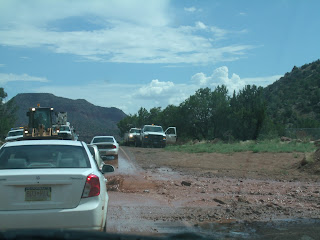
As soon as we left the Valles Caldera it started raining. It poured for a while so we pulled over and had some snacks of canned beans, chips, and cookies. When we got back down to Jemez Springs we could tell it hadn't rained as hard there but there are several low places on the road through town where the water pours across it when it rains in the higher elevations causing some smaller flashfloods. Flashfloods can be deadly if you get caught in a big one. We had seen were the road crews had be doing some work in these same areas when we had come through in the morning. Now they were going to have to work them again. In fact we had to wait about 15 minutes at one place to let the grader make it safe enough to cross. Here are some cars that were in front of us as we went across the bad places and some of the water running on into some natural ditches beside the road.


In this wash out the pavement had let go and there was a drop off of about 5 or 6 inches and then you had to go back up on the other side.


Much worse than these and the road would have been closed.

Sunday, January 15, 2012

Yodelin ..

It has been a while. I probably should do a year end recap, or a goals for the coming year before doing a new post for a new year. But that is not how it is going to be.


In a stroke of luck I had some time off. (we were slow at work) And Dan was in between jobs. So I lobbied to get out. Unfortunately, the weather didn't really cooperate and we weren't going to riding 12" of fresh. Bummer.


The forecast was somewhat miserable with sun and above freezing temps for the day prior to us getting out. No measurable snowfall in the previous few days either. This made us fall to the old standby of Yodelin.We both figured that a northern exposure, and trees would have protected what precious snow there might be. And as always, Yodelin never seems to disappoint.


We arrived in the parking lot to a light snow falling. The road in was horrible, an icy packed luge run with a dusting of new snow on it for the minimum in friction coefficient. As we went up, the snow fell harder and the snow underfoot was deeper. We started getting positive vibes. Up near the ridge, the snow was deep, and there was no readily detectable crust. We skinned through the cut and up into the trees to our transition point.


The first run was good. A little choppy and boney in sections where people recently laid tracks. We continued to the second road and really enjoyed the less tracked lower portion. So we skinned up again. Our track from the first run had a fair amount of new snow in it, making it appear a day old. This time we went further on the ridge to get out of tracked snow and had a nicer upper portion consisting of 4-8" of loose snow. (I hesitate to call it powder. But it was not concrete.) We once again continued past the first road and had a really good run through the trees to the final road where both Dan and I fell coming through the ditch by the road. At this point and elevation we were receiving some heavy wet snow and decided to call it a day as we knew the snow wasn't getting any better. We skinned back to the lift hut and transitioned back to ride the road out.


Saturday, January 14, 2012

The Homer Spit

The town of Homer, Alaska lies on the shores of Kachemak Bay, a sheltered arm of lower Cook Inlet on the southeastern tip of the Kenai Peninsula, and is “famous” as being the halibut capital of the world. But we didn't come here to go fishing!

Sue, Fred and I are sharing a campsite on the Homer Spit, which extends 4.5 miles out into Kachemak Bay. When we arrived in early afternoon (August 12th) the campground was nearly empty. By evening it wasn't completely full but it was highly occupied. Huge RVs pulled in all around us!

As you can see, the skies are rather cloudy. It has been a wet summer here - if it rains in each of the next two days it will be a record for the Homer area – 28 days of rain! Of course, it wasn't a steady, consistent rain for all those days. We can only hope for a dry day on Saturday for our little excursion.

A few hundred feet away from the campground is the Seafarer's Memorial, of which this is a part. The inscription reads “This Bell Tolls for all the Souls Set Free Upon the Sea.”

The Harbor at Homer Spit. Even on a gloomy day, it is beautiful.

The tides of Kachemak Bay are the second largest in the world. The average vertical difference between high and low waters is 15 feet, with an extreme of 28 feet. During low tide the angle of the portion of the pier sloping down to the boats can be as much as 45 degrees! The piers and boats moored in the bay all rise and fall with the tides. A short but fascinating movie shown at the Alaska Islands & Ocean Visitor Center in Homer revealed the dramatic differences between high and low tide. It was amazing. These pictures of the marina area were taken when the tide was higher (though I don't know whether it was at high tide or not).


All kinds of rules and regulations must be strictly followed!

The little shop along the waterfront for the “Time Bandit” which is one of the boats (they hunt for Alaskan King Crab) that has become famous (or infamous, depending upon your point of view) locally due to the series “Deadliest Catch” on the Discovery Channel.